
I am writing a book, “The Lost Tools of Business.” It is an attempt to share with organizations the secrets to growing successful cultures that I have learned through classical education. I’ll be previewing drafts of the chapters periodically on this blog. The following is the introduction. I would love–and need–your feedback. I hope this is a blessing to you or your team.
“We’ve just need a change in our culture.”
Over the years, almost all of my clients have told me that.
I have served more than 110 clients (at last count) since 2003. They often realize that there were opportunities to improve the culture by better communication, training, inspiration and intentionality. Through coaching and consulting, I’ve tried to help.
But around 2014, I made a discovery that unlocked a new level of performance for my clients:
My kids began receiving what we now call a “classical education.”
Before, say, 1890, classical education went by a different name: “education.” It was just how it was done.
It did not take me long to realize that this education was the key to all true culture change.
Our roots
Let me illustrate by highlighting three of the world’s most important philosophers. They were all connected with each other and with the civilization you and I still live in.
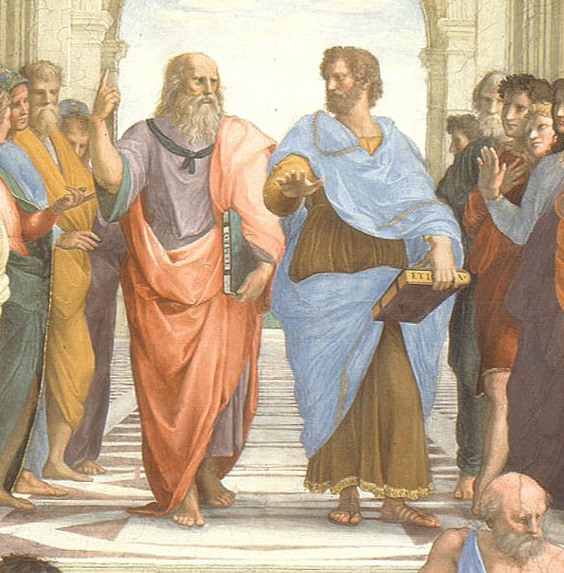
In the Greek city of Athens, Socrates taught Plato. Over time, Plato taught Aristotle. And Aristotle then taught Alexander the Great.
Alexander was Great in that he conquered an empire stretching from Greece to India. Do you have a town named Alexandria in your area? That gives you an idea of how influential his empire was: Millennia later, people still live in towns he named and in towns we name in honor of his culture.
His colonists spread Greek ideas far and wide—the Alexandria in Egypt had perhaps that era’s largest library. And the Romans who came after the Greeks borrowed their philosophy, art, religion … and educational system … directly from Alexander’s culture.
In fact, much of the Roman Empire spoke Greek, not Latin. Its elites used Greek slaves to tutor their children. That “Hellenistic” part of Rome eventually conquered an obscure Middle Eastern tribe, the Jews. The Roman Empire eventually executed one of the Jews’ teachers, Jesus of Nazareth, a Hebrew man who quoted his own scriptures using a Greek translation. After his execution, a new religious sect, the Christians, spread like wildfire all the way back to Rome.
The West
Athens, Rome, Jerusalem. From these three sources spring most of our culture.
It would fill a library to list all the contributions and innovations that Western Civilization gave to the world. Libraries themselves (and hospitals, and science as we know it, and mass printing and literacy as we know it, and coins and plumbing and democracy and—well, you get the idea) would be in that list, too.
That is not to say that the West is a flawless culture. Indeed, this book exists to counter some of the trends in the modern West. And note that previous efforts to reform flaws in our culture—abolition of slavery, for instance—came from within the culture. Its own people challenged society’s behavior by appealing to the West’s own ideals of Freedom and Equality.
Still, I would be remiss if I skipped over the concerns that the West is dominant merely because its geography and resources allowed it to dominate its neighbors.
The historian Rodney Stark observes that other civilizations had scientific breakthroughs earlier than Europe. So why did so much of it take root only in the West? Because Jerusalem had combined with Athens and Rome:
… since they were committed to reasoning about God, the Jews were quick to embrace the Greek concern for valid reasoning. What emerged was an image of God as not only eternal and immutable but also as conscious, concerned, and rational. The early Christians fully accepted this image of God. They also added and emphasized the proposition that our knowledge of God and of his creation is progressive. Faith in both reason and progress were essential to the rise of the West.
Rodney Stark, “How the West Won: The Neglected Story of the Triumph of Modernity,” Intercollegiate Studies Institute, 2015
This book is about the West’s educational system. Plato, and others borrowing from earlier scholars such as the mathematician Pythagoras, created it. Ancient monarchs spread it. But the early church fathers refined it so that it lasted intact as the educational system through the early 1900s.
And we have forgotten it.
The lost tools of business offer us a way out, by offering us a way back.
Our utopian world is filled with unlimited information, constant entertainment, global connections and a veil of privacy. But unlimited information enabled deep ignorance and stunted memories. Constant entertainment made us lazy and unable to reason well. Our global connections are many—but not deep, and therefore we are profoundly lonely. And the privacy we think we have emboldens us to uncivil violations of the dignity of others.
The lost tools of business offer us a way out, by offering us a way back.
Eastern thought—from mindfulness to Zen Buddhism—is a treasure trove often discussed in self-help books, business seminars and entertainment media.
But what about the treasures of the West?
Why is our government a democracy? Why a democratic republic?
Why was the New Testament written in Greek? Why did Jesus use the Greek translation of the Hebrew Old Testament?
Why have scholars said that all philosophers since Plato’s time are but footnotes to things he already said?
Why did modern civilization spring from Greece and Rome and Jerusalem when it could just as easily have sprung from China or Japan or India or Africa?
Methods for lasting impact
On the wall in the Vatican is a painting from Raphael (the human, not the mutant turtle): “The School of Athens.” It features the Greek philosophers—Plato and his pupil Aristotle in the center—who developed Western thought. All of these men lived in the B.C. era—some as early as the 500s B.C.
And Raphael painted his tribute around A.D. 1511.
At least 2,000 years had passed since some of these men had lived, and yet their impact lived on.
We’ve added quite a few more centuries to that tally since then. And here we are, still living in their culture.
Would you like your personal or organizational culture to be so strong that it lasts as long as the civilization created by the West?
My goal in this book is to introduce you to some of the concepts that helped build a culture so strong it has lasted millennia—and to suggest how to apply those concepts for your professional life.
Would you like your personal or organizational culture to be so strong that it lasts as long as the civilization created by the West?
Chapter 1 reveals the Greek word paideia (pie-DAY-uh), which translates as both “education” and “culture.” You’ll learn how the ancients were intentional about building their culture and how their concept of excellence informed that work.
Chapter 2 discusses schole (skoe-LAY), another Greek word with multiple translations: “school,” but also “leisure.” What if the very foundation of intentional culture-building was to intentionally pause and engage in restful contemplation?
Chapter 3 introduces the method that can be used during the intentional pause: the Trivium. It is how the Romans described the three language arts. And, in our era, it can be applied to any subject we wish to master.
Chapters 4, 5 and 6 discuss the Trivium’s three arts in turn:
- Grammar is the art of getting organized in our knowledge—by internalizing the basics.
- Dialectic is the art of getting confident in our understanding—by wrestling to the truth.
- Rhetoric is the art of influence, growing in wisdom while you take action.
Be an amateur
If there is a part of you intimidated to tackle this book, I want to encourage you to look at these topics as I do: an amateur.
The root word for “amateur” is the Latin for love. You don’t have to be an expert to chew on these timeless treasures.
It is too late (perhaps!) for you and I to take four years of Latin to sharpen our logic skills, or to sit under a professor of rhetoric to master our communication. We are past our years of “formal” instruction.
But we can still strive for these goals with what classical education scholar David V. Hicks labels half of classical education: a “spirit of inquiry.” That is, if you’re willing to have a general curiosity about things, and to use your imagination to explore them, and to follow a method to get answers, you qualify.1
In other words, you need a love for wrestling and growing.
My company’s motto is to do just that: Wrestle and grow. Wrestle with the West’s ancient wisdom, introduced in these pages.
Without the wrestle, we lack confidence. Self-doubt, lack of clarity and anxiety take over. So too do fear, conflict, lack of trust and ineffective communication.
Grow more organized in your knowledge, confident in your understanding and influential in your wisdom.
If there is even the smallest part of you excited about not just improving numbers and solving headaches, but about growing as a person, keep reading.
What resonates with you about this? What questions do you have? Please contact me or comment here.
1 David V. Hicks, “Norms & Nobility: A Treatise on Education,” University Press of America, 1979