
What if you had to stare at dust, constantly, for years on end?
What if that is what you are doing right now?
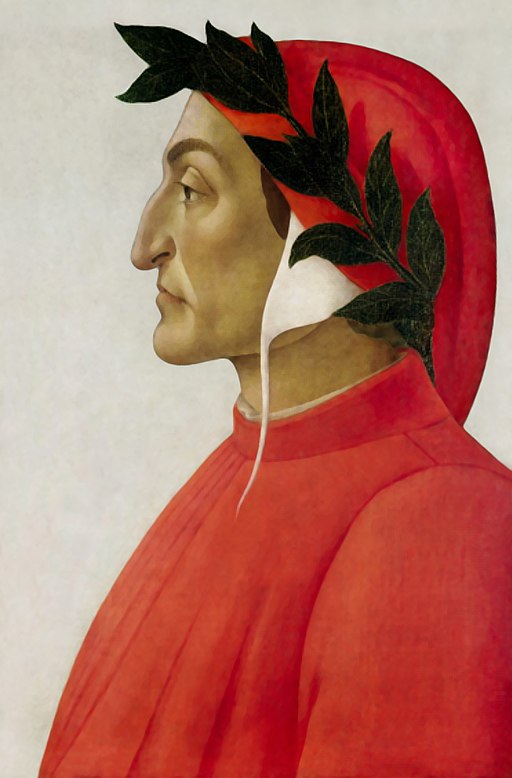
In Dante’s Divine Comedy, the poet (c.1265-1321) portrays himself as the narrator on a tour of Hell, Purgatory and Paradise. Set aside your theological issues: The epic is one of the world’s most important works.
Dante’s story gives us a Medieval conception of how the universe works. To do so, he weaves together classical literature, Biblical imagery, and Dante’s contemporary religious and political context.
It is crafted staggeringly well. For instance, It consists of three sections, each 33 cantos long, plus an introductory canto to make 100. Each canto consists of tercets of 33 syllables each. Hell’s setting is its infamous nine circles. The mountain of Purgatory has nine terraces. Paradise consists of nine celestial bodies. It’s all divisible by three–a somewhat important number if you believe in the Father, the Son and the Holy Ghost.
But such ornate structure is not a handicap. Dante still manages to create a story that is heartbreaking, hopeful and holy. At its core, it is a meditation on–and devotion to–Justice and Love, which Dante says are the same Person.
As you might often ask here, “Cool, Mark … but what’s this have to do with a blog about the workplace?”
What is the therapy for greed?
One way to answer that question: Dante has given us a wonderful opportunity to wrestle with important questions for how we live our work lives.
For instance, he is provocative in how he assigns punishments to mythological heroes, Bible characters, and Italian popes and politicians.
Take greed.
In the fourth circle of Hell, the misers spend eternity rolling boulders with their chests in a jousting match with their opposites (who squandered their wealth). Dante tells his guide that he suspects he could recognize a few of these sinners. The other parts of hell are filled with cameos of famous people. But in the part punishing the greedy, Dante’s guide says he won’t be able to recognize anybody:
“Forget it,” the guide says, “it’s an empty thought. / The nothing-knowing life that made them foul / dims them beyond all recognition now.”
Why? Why would pursuing wealth be a “nothing-knowing life?” Why would it make one unrecognizable?
The guide explains:
… For all the gold that lies beneath the moon
and all that has, could never give a moment
of rest to one of these exhausted souls.
The greedy pursue something that won’t actually give fulfillment. If you chase the same thing, you will lose the very essence of who you really are–the part of you that can truly find fulfillment.
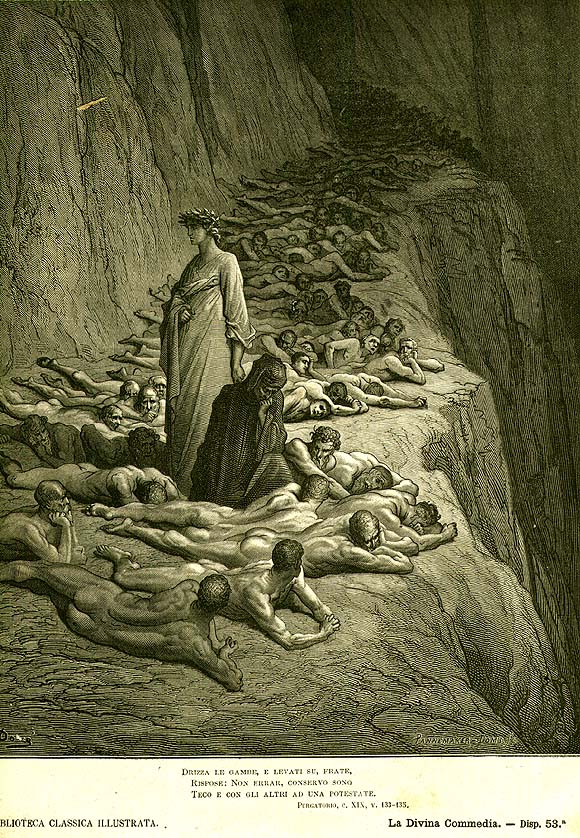
Later, on the mountain of Purgatory, Dante finds more of the greedy–except these have accepted Christ.
They are saved, but they must make penance to ready their souls for living in God’s presence.
They willingly do this, a kind of spiritual therapy.
And what is this “therapy?” As in Hell, it fits the crime. The penitent lie face-down in the dirt.
They weep as they sigh and pray Psalm 119: My soul clings to the dust; give me life according to your word!
In Hell the punishment is constant motion, fighting over boulders.
In Purgatory, the therapy is inaction, weeping in the dust.
Why? Dante does nothing just for visual effect. All of the Divine Comedy is intentional.
“You can’t take it with you,” they say. And, “Hearses have no trailers.” The house, the car, the boat, the jewelry–it will all end up as dust.
A greedy pope undergoing his penance explains to Dante:
What avarice does is manifested here
by the purgation of the souls turned round.
No pain upon the hill is more severe.
For as our eyes were never raised on high
but fixed themselves upon the things of earth,
here justice humbles them to touch the ground.
In Hell, the condemned greedy never stop chasing their wealth–which is really just rock. In Purgatory, the penitent greedy lay down in their wealth–which is really just dust.
It begs the question: What are you and I chasing? Where is our focus?
What is worthy?
I don’t want to make this post too long as I muse about all the ways this plays out in the workplace. But I think it might be worth thinking about lottery winners.

You don’t have to do a lot of research to know that, just because people come in to money, they don’t suddenly have a great and fulfilling life.
I have worked with self-made men who are now millionaires. They have made enough wealth to change the trajectory of their future generations. And they are miserable.
I have seen the poor striving for the same wealth, just as miserable.
I have also seen individuals who needed a change of heart who were so insulated by wealth that they never stopped to pay attention to the cries of their heart.
None of that works out in the long term. It certainly doesn’t work out in the eternal term.
Let’s take it one step further: Just because you are looking to wealth for a good cause does not protect you from this mindset.
Perhaps you plan to start a charitable foundation that will impact the entire globe. Perhaps you are a church, seeking to fund an important ministry. Perhaps you are a politician with all the right convictions, just needing some funding for your campaign to change the world.
If the focus becomes the wealth–what Dante identifies as dust–you could be headed for disaster. Relationships are more important than the money, even for good causes. Your cause may be righteous … but who did you step on or neglect to achieve it?
I think that’s the real message of Dante on greed. The lost person loses who he is in the chase for wealth. The saved person is so focused on wealth that he stops looking at God.
He just looks at the dust.
Who do you have an opportunity to look at today?