
Taking action is a challenge. Sometimes, that’s because you can’t decide on which action to take. “I just know what I’m doing now ain’t working.”
Other times, it’s because you know your actions are working … but you don’t like where it’s taking you. “Something’s gotta give.”
There is help available for both situations. You’ll find it in the following brief refresher on English and a related story about King David of Israel.
What is Is?
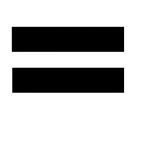
I’ve noticed that there is a special word that sneaks into every conversation my clients have about making progress. That special word: is.
Do you remember the difference between nouns and verbs?
Nouns come from the Latin word for “name.” They are the names of things: people, places, concepts. It is a label, an identity: Accountant. Hill. Democracy. Mark.
Verbs, by contrast, come from the Latin word for “word.” They are the actions–what nouns do: Run. Fight. Love.
And many words work both ways. They are nouns and verbs: Runners run. Fighters fight. Lovers love.
But there is one verb that can act as an equal sign, tying two nouns together: Jamie is a runner. Spartacus was a fighter. It can also tie nouns to descriptions: My wife is beautiful.
In other words, the verb “to be,” in forms like “is” and “are” and “was,” connects a name–an identity–to another identity. It gives the noun that is the sentence’s subject a further identity. “Jamie” is the subject of the sentence. And thanks to the sentence, we now know Jamie is a “runner.”
It’s magic
You can think of it as a magic spell, giving something a new or expanded identity.
and Out Blues” is a fox trot.
If that seems overblown or silly to you, I want to encourage you to think about this. Words matter.
You know this already if someone in your life has said you were a failure or are a disappointment … or fat … or ugly … or stupid.
Or maybe you say these words to yourself.
These labels can be crippling. If you think you’re, say, a failure, it will be hard to take action or know which action to take. Failures fail, after all!
Even when the labels are positive, it can be a problem. We’ve all known somebody whose parents told her she would be a doctor some day. And maybe she wanted to be a doctor. Maybe she even became one and now is a doctor. One who is very busy working with patients and growing her practice.
But it’s not who she really is, and she is miserable as a result.
There is a solution for all of these problems around taking action. It involves that “failure” or that busy doctor to STOP trying to take action.
It’s time to be.
David’s secret
Coaches are fond of saying, “There is a reason we are called human beings and not human doings.”
The life of King David gives us a beautiful view of how good life can be when we put being and doing in the proper context.
David was a masterful doer. As a youth he decides in an instant to kill a giant. He plays music, writes songs, fights battles, takes on armies, escapes murderers, dances in worship–the list goes on.
He also “does” some awful stuff: seduces a married woman and conspires to kill her husband.
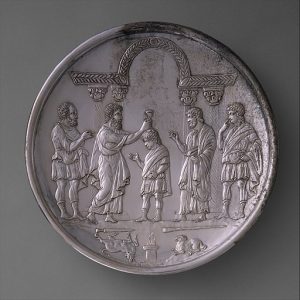
David anointed by Samuel (Byzantine plate)
And here is where the magic “to be” verb shows up. When David is successful, it is because he has spent time thinking about who he is. When he is not successful, he gets back on track by … spending time thinking about who he is.
There is a famous interaction in 1 Chronicles 17 where David plans to take action: to build God a temple. What could be more noble?
But David’s court prophet hears from God that no, David should not do this. The reasons go beyond the scope of this post, but suffice to say that the prophet corrects David’s error in judgment.
Instead of compounding his error by taking another action–sulking, for instance–David “went in and sat before the Lord and said, ‘Who am I, O LORD God, and what is my house, that you have brought me thus far? …'”
David decides to “just be” and consider his identity: “Who am I?” And notice that who he is … is someone God has taken care of. His identity is in relationship to God. In the narrative of David’s life, before he took any actions at all, an action was done to him. As a boy, a prophet anointed him king. God chose him.
Take action by taking stock
Eugene Peterson’s absorbing meditation on the life of King David has this nugget for us:
Traveling through scenic country, we sometimes come upon a sign reading, “Roadside Vista Ahead.” In anticipation we slow down. And then we’re there; we pull off the highway, get out of our car, stretch–and look. … We can’t always be driving, watching the road closely. Not driving is also part of the trip–savoring what we’ve done, absorbing the landscape, letting the contours of the land and the colors of the horizon sink into our imagination.
It’s metaphor for life. We have many opportunities to slow down and take a look at our lives: birthdays, anniversaries, retirements, reunions, etc.:
These are connective moments. … Honoring them is one of the ways we have of keeping our lives coherent–keeping what we’ve been connected with what we’re becoming. Without frequent reconnaissance we’re in danger of living in spasms without coordination, without rhythm.
Eugene Peterson, “Leap Over a Wall: Earthy Spirituality for Everyday Christians”
We would do well to take a page out of David’s playbook for taking action. Don’t wait for a milestone birthday to prompt you. Right now, stop to figure out who you are.
People who know who they are have a much easier time taking action. Think of times you or your team have made a quick decision by saying, “That’s not who we are.”
They also have an easier time being comfortable where their actions are taking them. I know a soft-spoken Judo sensei who has a good sense of humor about life. I was surprised to hear him describe his early days teaching youngsters. He yelled at them.
“They didn’t like it, and I realized I didn’t like it!” he told me. So he decided to change who he was. The results–the hundreds of students–speak for themselves.
Is it time you pulled off the highway and took stock of who you were, are and are becoming?
Break out your journal. Sign up for work with me, such as a vision and purpose retreat. Do something that gives you time to be … and to figure out who you want to become.