
“Now Dad, your job is to hold her shoulders down. Don’t let up under any circumstance.”

When my oldest turned 1, the pediatrician wanted to do some bloodwork. He wanted to eliminate some concerns, and to do that, he needed vials of blood.
I pressed her shoulders against the mat. The nurses pierced her and began to draw out blood. She cried out in surprise and tried to escape.
I pressed firmly. Her surprise turned to terror. She couldn’t talk. But I can still see her icy blue eyes, crying, pleading with her father to save her.
It seemed to go on forever. It went on so long that she eventually lost her ability to cry. All she could do was make a gargling sound as she stared at me in despair.
My heart was broken.
Now the rhetorical question:
Do you think I would have relented my hold for even a second?
Last month, I wrote to managers about allowing faith in the workplace to help deal with despair. In this post I want to talk directly to clients and friends who are wrestling right now.
Frankly, I’ve put off posting this because I know the wording isn’t right. I’ve been fiddling with it. But I am feeling some urgency about this.
My clients and friends struggle with the presence of pain, and the absence of purpose. They struggle with the weight of guilt, and the wounds of relationships. They are suffering, and I am done losing them to suicide and other deaths of despair.
If that describes you, I want you to know the following thoughts, however disjointed. I am praying this helps equip you to get through your dark season.
His ways are not our ways
My daughter did not understand any of my actions. They were logical. They were for her good. But they resulted in her experiencing pain and fear.
More accurately, they temporarily resulted in pain and fear. I had a longer view in mind. I knew it was but for a little while. That it would result in us keeping her healthy.
The Bible tells us God has the longest view in mind. The eternal view.
Our souls may be immortal, but our view of space and time is finite:
For my thoughts are not your thoughts,
Isaiah 55:8-9
neither are your ways my ways, declares the Lord.
For as the heavens are higher than the earth,
so are my ways higher than your ways
and my thoughts than your thoughts.

Not only are our thoughts different from God’s, they are lower than God’s. We cannot see the whole picture.
I take great peace from that, knowing that there has to be more to the story then what I am experiencing right now.
Sometimes I get to see that mystery solved on earth. For instance, I recently felt led to give up work with a client to make room for another client. Then the other client fell through. How was I going to feed my family?
Then I got a longer view: The original client canceled its project and “fired” my colleagues. And several new clients approached me for work. I wouldn’t have had time for them without the ending of both the client I quit and the client that fell through.
But sometimes I do not get a mystery solved. I am left in suffering. And I am called to trust that the mystery will be solved once I’m in eternity, seeing God’s eternal view. Even if I don’t know what it is, there is a purpose.
Our suffering points to something Good
Perhaps you struggle to believe that such suffering could exist if there really was a good God.
I have hope in this: The fact that you and I recognize suffering is real means something.
We humans have the ability to know that we are hurting. That is to say, we know that we are experiencing something that is Not Good. And if our present state is Not Good … that means there is something that is Good.
I have often found that the beginnings of depression get my attention and force me to seek his help. God has used loss or fear to drive me into a tighter relationship with him.
![By unknown; a copy of the painting of François II Quesnel, which was made for Gérard Edelinck en 1691[réf. nécessaire]. - Own work, CC BY 3.0, https://commons.wikimedia.org/w/index.php?curid=12193020](https://www.hipsocket.net/wp-content/uploads/2023/03/pascal.jpg)
The same could be said for times when everything seems meaningless to us. It is an incredibly common modern condition, meaninglessness. It explains so many extreme things in our world, from childhood mental health/suicide to mass murder to family abandonment to “deaths of despair.”
We’re not sure life itself has meaning. We know politics haven’t solved the problem, and even escaping cycles of dysfunction isn’t enough (warning: article at link is excellent but features rough language).
Sometimes we fill the meaningless with temporary fixes: promotions or pornography, substance abuse or charitable work, binge-watching or binge-eating, giving our kids everything or giving ourselves lifetime memories.
You’ll notice that some of the items on that list are good things. Yet they cannot fill Pascal’s “God-shaped hole:”
What else does this craving, and this helplessness, proclaim but that there was once in man a true happiness, of which all that now remains is the empty print and trace? This he tries in vain to fill with everything around him, seeking in things that are not there the help he cannot find in those that are, though none can help, since this infinite abyss can be filled only with an infinite and immutable object; in other words by God himself.
“Infinite and immutable.” God has always been there, even before there was a “when.” And God has not changed: He has always been completely good, completely just, completely loving.
Notice photographer and uber walker Chris Arnade’s synthesis of all this:
And by the way, that transcendent God came to earth to endure all the suffering we wrestle with.
Loneliness, shame, physical pain, unjust treatment, prejudice … I think all of that happened in just the last week of Christ’s life before the torture and execution at what seemed to be the end.
At that moment, hanging on the instrument of execution called a cross, he quoted ancient King David’s song lyric: “My God, my God, why have you forsaken me?”
If you have experienced that existential dread of a godless world … the possibility that there is nothing in life that rises above what you are experiencing with your five senses … if you have worried that this is all there is and that you cannot escape that reality … know that Christ experienced that on the cross. He was cut off from the Father.
And he did it, by the way, “for the joy set before him.” He did not endure because the world mistreated him. He chose this path to buy us back, so we can be adopted.
In other words, it is now possible to fill that “God-shaped hole” and enjoy him forever.
“That I … may share his sufferings”
Our suffering may have a purpose we can’t see. And our suffering may reveal how the things that do not satisfy here point to a God who is all-satisfying.
But for all that, the suffering may not go away. Yes, even for Christians. Remember my daughter’s pleadings.
What does that look like? Practically speaking, what does a Christian have to face our world besides some positive outlook in the future?
For a modern outlook, I’d suggest you listen to a podcast episode on the chronic pain of Mike Nelson, the legendary host of Mystery Science Theater 3000 and RiffTrax. The followup episode on suicide is equally insightful–and humorous.
For an ancient outlook, consider the life of St. Paul.
After God saved him, we know he was tortured, left for dead and abandoned–multiple times. He was imprisoned on trumped-up charges. He struggled with a physical ailment, probably blindness.
Yet he found, literally, joy in suffering. Read his letter to the church he planted in Philippi.
(It bears special meaning for readers of the Hip Socket blog: Philippi might be considered ground zero for the West:
- It was named after Alexander the Great’s father, using (like much of the east) the language and culture of the Greeks.
- It was part of the Roman Empire, with many retired soldiers in its citizenry.
- It was the first site in Europe where Gentiles heard about Jesus from Paul, a Jewish missionary.
Greek, Roman and Jewish. All the elements of what we call Western Civilization were in place, perhaps first, at the church in Philippi.)
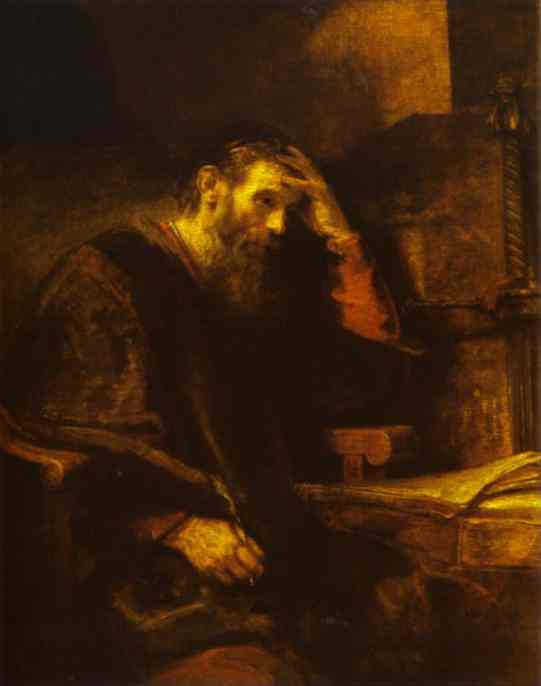
Paul wrote to this historic church from prison. He mentions his chains. He says he has fellow preachers who consider him a rival and are glad he is in prison. He relates the near-death of a close partner. He cries as he explains that some of his people have abandoned their faith.
All discouragement and depression.
Yet he found joy in his suffering. Perhaps it is an insult to call Paul’s thinking “positive psychology,” but he focuses on the good:
His chains led to him sharing Christ with the Roman guard and others in the capital of Rome itself.
The preachers who competed with him merely led to more preaching of Christ.
His partner’s willingness to risk his life was worthy of honor.
Those abandoning the faith were cause for Paul to encourage the others to be on guard and stand firm.
And he was able to stand up under the weight of all this grief by meditating on Christ.
To quote the letter:
Finally, brothers, whatever is true, whatever is honorable, whatever is just, whatever is pure, whatever is lovely, whatever is commendable, if there is any excellence, if there is anything worthy of praise, think about these things. What you have learned and received and heard and seen in me—practice these things, and the God of peace will be with you.
A God of peace. I have known people who struggle with depression and pain and enemies. They are wounded in many ways. Yet taking refuge in the God of peace–in the good things that he is the source of–gives them joy in the midst of the suffering.
Paul was so bold as to say of Christ that he wanted to “share in his sufferings.” That was purpose: to suffer for Christ.
Others have noted that we need to “up and be doing,” letting that suffering draw us to Christ.
I know these thoughts are still in draft form, but felt an urgent need to publish them for any of you suffering right now.
I hope this helps you. Regardless, if you have not reached out for help, please do so now. Send me a message. Contact authorities. Do whatever you can to give yourself some safety and connection as you navigate the waters.
You matter to us. I’m praying for you.