
More information continues to come to light on what our employees and customers think about the metaverse.
I am, of course, talking about middle-aged people paying off home mortgages from talking raccoons.
I owe Tom Nook, like, 90,000 Bells
If you’re not familiar, Animal Crossing is a game where you (or, I should say, your cute avatar) arrive at an island and set up house.
That’s it. That’s the game. You take out a loan to build a house, buy stuff to furnish it, and work off your loan with a series of activities that allow you to interact with the talking animals who live there.
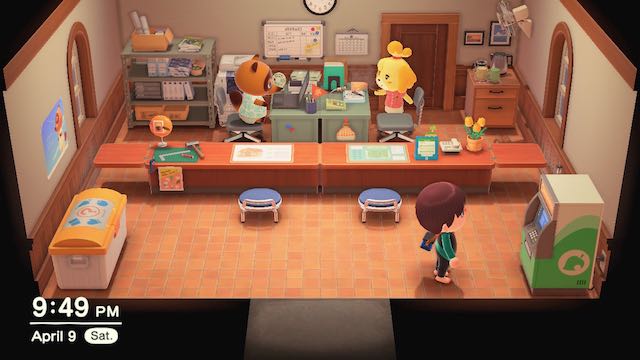
You fish, hunt for shells, plant and harvest fruit trees, exercise with your neighbors, and remodel your home–which requires another loan, starting it all over again.
It’s as mild as it sounds. This weekend there was a fishing tournament. And now there are eggs hidden on the island for “Bunny Day.” It’s cute, silly … and addictive. Yes, that’s my avatar in the screenshot above.
I’m not playing a game, I’m, uh, experiencing a simulation
To defend myself: I never had an Atari as a kid. Or a Nintendo Entertainment System. Or the systems that came after it.
So this Christmas, I gave my kids something I never received as a youngster: the latest and greatest video game system. (Many thanks to Johnny for the amazing hookup!)
And that was when the madness began. I think my wife has a bigger problem than I do. We log on AFTER the kids are in bed to do things like harvest wood to make furniture.
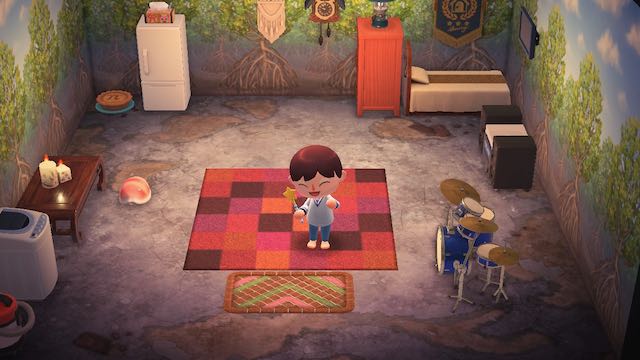
It turns out we’re not the only adults playing.
In the fall, Nintendo revealed the customer demographics for its current gaming platform, the Switch. The company had sold 90 million units. And 250 million customers have online Nintendo accounts–32 million of those paying for services such as online play, classic game emulators and cloud backup.
Given that, it won’t surprise you that most of those users are adults.
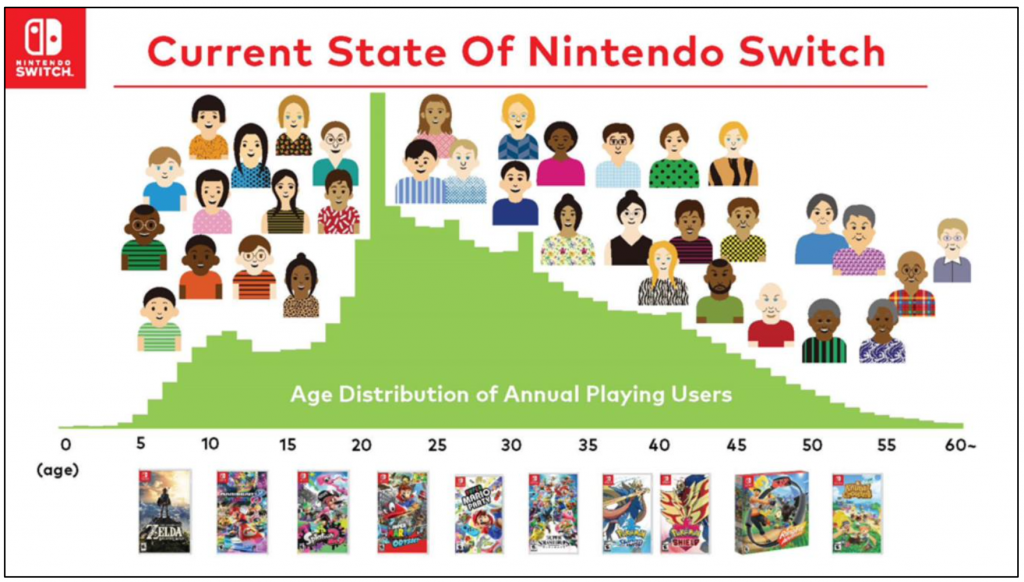
Nintendo’s graphic indicates that most of their customers are at least 20 … and the age bracket doesn’t really taper off until about 40.
That would be younger Generation Z all the way through Y and to younger Gen X. What’s going on here?
Animal Crossing gives us a clue. It has to do with civility.
“No one here is alone, satellites in every home”
Part of the charm of Animal Crossing is that it is “kind.” By that, I mean that all the characters treat each other kindly. It is not a roleplaying game where you have to somehow defeat the computer or other players. There are no fights, not even hurt feelings.
Take my recent interaction with a new island resident, Midge. She was happy to see me and happy that I stopped to chat. The game, of course, keeps track of who I am interacting with. (There are even a series of buttons to press to “react” to another with everything from delight to shock–you know, showing empathy?) Sometimes, as a result of interactions, the characters (i.e., the computer) send me gifts for my home.
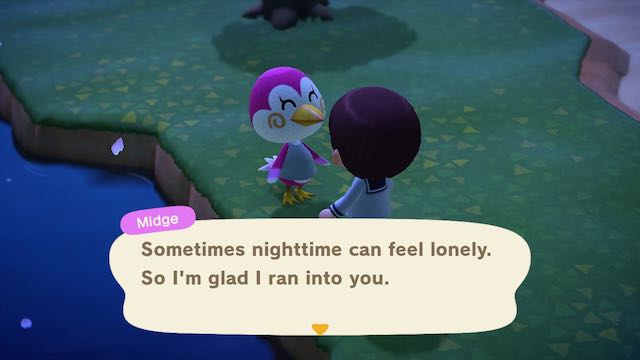
Meanwhile, my kids have characters too. We can send each other gifts as well.
We can also teach the computer’s characters sayings, or make them clothes with designs on them.
In fact, we could invite other players to visit our island. And they could do the same.
Do you see where I’m going here? Say your little Billy invited his friend Rex to visit your island. Rex could introduce ethnic slurs to your computer characters, or design shirts with swastikas. Not nice!
Never fear: Nintendo thought about that. Meet Isabelle, who helps run the island.
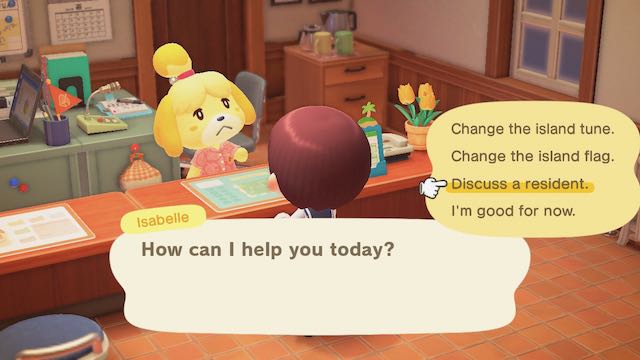
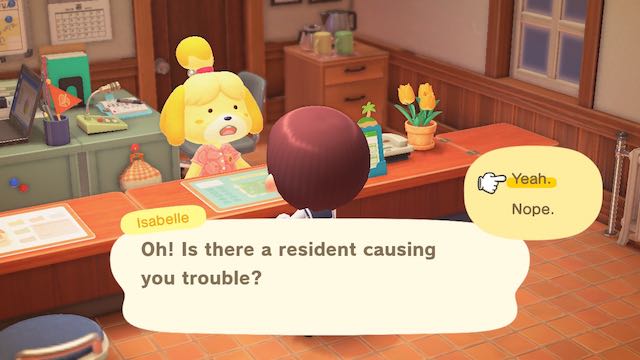
She will police out any foul behavior.
Yesterday, I posted Blur’s hit song “The Universal.” Its anthemic melody contrasts with its dystopian lyrics. In vague phrases, it describes some free, widely available state (a drug?). Those experiencing the Universal sing karaoke every night, anticipating a rosy future that never arrives. Meanwhile, their houses are bugged.
The song was big, as they say, in Japan. I wonder how often it makes the Japanese think of their communist neighbor’s “social credit” system?
I wonder how often either makes them think of Animal Crossing?
None of us want a monolithic Big Brother government monitoring our every move, keeping things “nice,” modifying our behavior.
But a video game world I experience as a customer? Sure. It’s an escape. Nintendo employees are masters at “surprise and delight.” There is such a loyal following to Animal Crossing that customers have already made a fan video joking about Isabelle playing the latest hit game–and have demanded that she be a playable character in a fighting game!
All of that is to say this:
Is your workplace and your customer experience a “clean, well-lighted place?”
Nintendo, fancy toast and you
Ernest Hemingway used the phrase in his classic short story, describing a suicidal patron of a cafe who stays too late and drinks too much. Everyone needs a place to keep them from existential dread, after all.
That’s my simplistic synopsis.
I don’t want you to think of your organization as offering merely a balm on top of hopelessness. Partly because it’s not hopeless. And partly because, in fact, I know some of you work for ministries and churches. I think every organization has an opportunity to make eternal impact–and surely that includes you!
But: In modern life, many customers (and employees) lack the safety nets, support and consistency found in traditional communities. Service industries can provide some of that, in measure. (Don’t believe me? Read about the incredibly poignant origins of artisanal toast.)
It just may be that your organization can offer an oasis, a clean, well-lighted place, that serves your clients and inspires their loyalty.
Ideas from Animal Crossing:
- Give your experience a predictable–and enjoyable–rhythm. In Animal Crossing, each day starts with news from the island’s office. When you visit various building, you know you’re going to receive a greeting from the host. The consistency is oddly comforting. May experiencing your organization be likewise.
- Allow customization of that experience. We are a personalization culture. To fine-tune or customize is to make me more invested. That goes for designing the flag for my island, and it goes for letting a business know how I want to interact with them.
- Celebrate at every possible excuse. On Animal Crossing, there are constant parties and festivals. Special things happen only during those events–hidden eggs, special guests, hard-to-find items. Can you be likewise? Checked your community calendar recently?
- Surprise and delight. On the island, balloons occasionally float over with gifts tied to them. Or a visitor who needs help washes up on the seashore–who gives you a gift if he helps. Heck, when you lay down on the bed, you realize you have the opportunity to dream-visit other islands! I heard about a used car operation that hid gas cards at the gas cap. Customers didn’t know about them until their first fill-up. What can you do?
- Honor dignity in tangible ways. Animal Crossing makes a point to police bad actors, and perhaps you do the same. But what about setting some standards for how you will treat colleagues and clients like they are worth something? More on that here.
I hope all this silliness gives you some ideas for being creative with your team. You just might be the clean, well-lighted place your customer needs today. And they just might stick with you as a result.