
This is the latest in a series about the DISC behavioral model. If you’re interested in taking Wylie’s DiSC assessment, I’d be happy to help. There are also lots of resources to explore on Hip Socket’s dedicated DISC page.
Are you a “personality test skeptic?” Do you think all these letters and reports to describe people are a bunch of hooey?
My mother agrees with you.
Mom is incredibly proud of me … and completely unconvinced that any of this personality test stuff is real.
You and Mom have some valid concerns, and I’ll address them below. But let’s get one thing straight first:
Any personality assessment worth its salt is NOT a test. You cannot pass it or fail it. You are simply responding to prompts, and those responses indicate you have a preference for certain things. That’s it.
Misunderstanding this is the exact reason Mom has trouble with personality assessments. To use her words, “You end up pigeon-holing.”
Pigeon-holing others
Not only are good personality assessments not tests … they are also not some kind of online pop-psychology “which Friends character are you?” quiz. Those can read like a horoscope, where it’s so vague that of course it describes you.

No, DISC tools from the likes of Wylie and Crystal are research-validated.
So well-researched, in fact, that many people get excited when they see how accurately they describe their behavior.
Because of this experience, many people will be tempted to commit the grave sin of pigeon-holing.
Pigeon-holing happens when you are so trusting of the tool that you take it at face value to describe everyone around you.
This can really come off the rails: “Bob is an introvert, so we’ll put him on the problem-solving committee. Introverts are smart.”
Does Bob agree that he is an introvert? Are all introverts smart?
Another one: “You’re a Dominant in DISC, so you’ll be great at sales.”
Not necessarily. These are all fallacies (see our resource page for more).
Pigeon-holing happens at two levels. First, we “brand” somebody as a certain type. That label may not be at all accurate, and we haven’t verified that the person agrees with the label.

Humans have an amazing power to name things. As we have discussed here before, it’s a job we’ve had since the beginning. Naming someone an [INSERT PERSONALITY TYPE HERE] could stick with them permanently … for better or for worse. For instance, someone given the label of Conscientious might be seen as so detail-oriented that they get passed over more visionary roles.
Second, our label may be so stereotypical as to be unhelpful. The styles DISC describes are broad brush strokes, four general patterns noticed for thousands of years. The patterns revolve around two sets of preferences: how we assess the world and how we interact with it. But we have more than two preferences that make up who we are. You could add in various other psychological dimensions, many influenced by our gender, birth order, socioeconomic status, faith background and so on.
DISC describes four basic types … but the model does not claim that there are only four types of humans. (It’s why I particularly like Wylie’s assessment, which captures not just your “DISC letters” but a map of your priorities, which often will go beyond what one of the four basic types would claim.)
Whenever I offer the DISC assessment, I spend some time describing the different styles and ask the person to identify which one best fits their style. We then compare this to the “official” report. Usually they validate the person’s opinion. But if it does not, the person being assessed gets the final say.
That means that their boss or coworker does not. Nobody likes to be labeled and stereotyped. Especially when how others view you could impact such important things as what career opportunities you receive.
Pigeonholing yourself
Another danger is pigeonholing yourself. There are two issues here.
First, you can limit yourself. In coaching, we talk about limiting beliefs. If you “believe” that because you are a certain personality style, you can’t do certain things or be certain things, that is the very definition of “limiting.”
It is like the example above of a Conscientious person who is passed over for promotion. But instead of others labeling them, they label themselves: “I’m a Conscientious. That means I need some alone time to recharge, so I’m not going to meet with my staff this week.”
Maybe this person is in the wrong role. Regardless, their team needs them to fulfill the needs of leadership.
It would be fairer to say, “I’m a Conscientious. I recognize that forced social interaction drains me. But I enjoy creating systems, and I need to create a system that allows me to do two things: interact with my team, and protect my calendar for time to work independently.”
(Those are ideas, by the way, lifted from a Wylie report on a C I work with.)
Second, you can excuse yourself. Just because you have a preference for a behavior doesn’t mean it’s a good behavior. We have all known that person who commits antisocial behavior and then immediately says, “Sorry, that’s just who I am.”
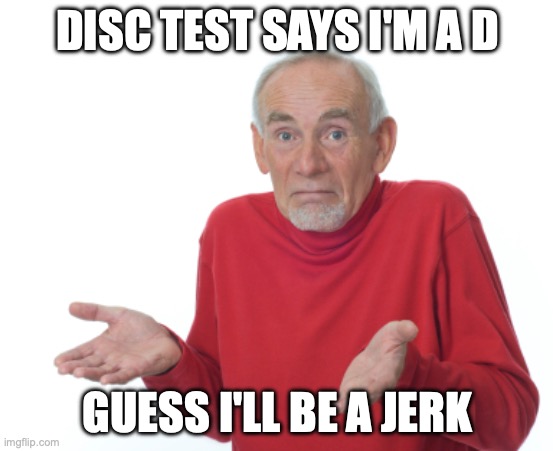
“Sorry if you don’t like my harsh words. I tell it like it is! It’s just who I am.”
“I’m sorry I didn’t send you the report I promised. You know me: I’m focused on the vision, so I forget about the details.”
“You’ll have to excuse that angry outburst. You know my style: I’m just so passionate about what I believe.”
In all three cases, the person has wronged another but assumes they get a pass because the wrong came from some unchangeable part of their nature.
There is an alternative: You could work on yourself.
I particularly like professor Trevin Wax’s take: “Your Personality Test Doesn’t Give You a Pass on the Fruit of the Spirit.” I’d encourage you to read it this week before Easter.
He notes that the “it’s just who I am” defense doesn’t cut it in the Bible. Instead, we’re called to follow Christ’s model. Paradoxically, this actually allows us to better live out our personalities:
A personality test doesn’t define you. God does. And what’s beautiful about the biblical instruction regarding our talk and temperament is that this is one of the ways we reflect our Maker. … Becoming more like Christ doesn’t mean becoming less ourselves. We become our truest selves when we reflect him through our personalities.
As we say around here: Wrestle (with your personality assessment) … and grow!