
I recently had the chance to speak to the incoming freshmen in the Honors Program at my alma mater, Eastern Kentucky University. Back in my day, we didn’t have fancy launch banquets. But then again, I started there almost 30 years ago, which means I sat at a table of people 30 years younger than me.

First things first: You heard about BeReal here in April of 2022, when it was just taking off. It’s part of Hip Socket’s ongoing conversations about the need for authenticity in a postmodern era. It has even affected the Horn Sections Make Rock Better posts. (See the most recent customer-oriented post as well.)
Anyway, I was right: The kids have come to like BeReal. Almost every student at my table used it. One had even made a commitment to her circle that, now that she was away from home and on campus, she would post on BeReal every day so they could stay in touch.
Second things second: My mission for the night was to give advice to the students. This message perhaps applies to anyone hoping to start just about anything. So I’ll share my thoughts below.
~
Value
What’s the value of the dessert set before each of us?
You might say 5 dollars or so. But if you had to measure the value of the desert by the pleasure it brings, it’s more like 5 minutes. Maybe 10 minutes if you take the time to savor it.

What if we changed our discussion to the value of … a new pickup truck? It’s worth tens of thousands of dollars. But its value in terms of time is limited to the hours you use it for transportation, hauling and towing, etc. And most likely it will wear out. Cars do rust. So its value could be measured in decades.
Now let’s get more abstract. What’s the value of an education? It should be a lifetime of value. It should help you secure a paycheck. You might buy lots of desserts, lots of trucks!
But we can’t leave it there, can we? You’re about to take a class called The Self-examined Life. So far we have stayed pretty surface. Surely an education is about more than getting a good job and buying things.
Relationships
More on that in a minute. First let’s get even more abstract. When I do this value exercise with clients, I show pictures of desserts, trucks, diplomas. Participants guess the value of each object as measured by time. Then I show a picture of a father playing with his child. Someone always yells out, “Priceless!”

I turn up the intensity by then showing a closeup of a child. Occasionally, someone will tear up.
Why?
What is it about time with others, and others themselves, that make us think their value can’t be measured?
I think I know the answer: Something deep inside of us knows that other people–and our relationships with them–are objectively meaningful. People count. They matter, they have dignity.
Dignity comes from the root word “worthy.” People are worth something.
If that’s true, then you should take the opportunities before you:
Set down your studies and do fun things together.
Go to that study group.
Take Adventage of the Honors Program trips.
In other words, slow down to take the time to invest in the relationships.
Ideas
But we can’t stop there. Because there is something else that has enduring value: ideas.
You are studying ideas. For instance, you will read Plato’s “Apology.” Plato had a thing about what’s real (not exactly the same as BeReal). I think he’d say that a truck is NOT real. It changes over time, rusting and so on. It is not eternally constant. The concept of a truck, however, does not change. We can perceive it forever in our mind.
And maybe a truck isn’t worth thinking about–although I hear one of the tables in the back had a discussion about what constitutes a pie?
Here’s what is worth thinking about: Things like justice. What is it?
What is truth? What is love?
These are elements of the liberal arts. They did not mean left-wing. The liberal arts are the skills one needs to be liberated. To keep yourself from being captivated by a tyrant’s words, or swayed by the passions of a crowd.
I would even say, to keep you from being swayed by your own emotions. To keep you from short-circuiting reason.
Schole
“The unexamined life is not worth living,” Socrates said during his trial. He then chose death over exile.
What was so bad about exile, that he would prefer death to it? He did not want to be cut off from the community that helped him wrestle with these important concepts. He did not want to miss the chance of discussion important questions about what justice, truth and love are.
So now we are talking about relationships and ideas. The Greeks called it schole. It’s the word from which we derive the word “school.”
But it literally meant “leisure.”
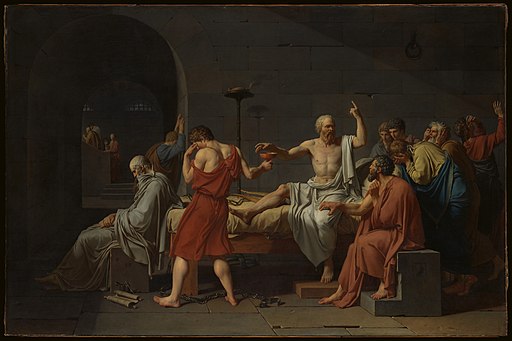
It takes time not just to build relationships but to let the dust settle, to slow down and think about important things. And Socrates was on to something: Such slowing down and thinking is best done in community.
Last month I spoke to another Honors Program grad who is now a college professor. She was also the first in her family to graduate from college. I asked her what advice she would give new Honors students.
She said to take advantage of the community opportunities as much as possible. That was what got her through undergrad. Grad school was easier, because all students in the community were excited about the same subject and gave each other needed encouragement, support and energy.
Undergraduate education doesn’t have that–unless you make a community intentionally with other Honors scholars. Do you see the connection between learning these ideas and having these relationships?
So engage in schole. Slow down to open yourself to relationships. Let that help you engage in the ideas. Those things are the truly enduring value of your college experience.
(But I hope you get to buy lots of desserts and trucks, too.)