

I have a client who has been reading coach Urban Meyer’s “Above the Line.” Meyer discusses the Success Formula:
E + R = O.
That is, an Event plus my Response to that event yields the Outcome. Events happen to us. What is under our control is how we respond to those events.
Meyer points out that it is not one, big heroic, cinematic moment, one life-changing Response, that we are talking about. It is the little choices. The daily habits that (perhaps) put us in a position to overcome an event.
It reminded me of an earlier book, Dr. Henry Cloud’s “Boundaries for Leaders.” In discussing what leaders can do to get results, his relationship-focused book mentions that leaders are “ridiculously in charge.” Leaders can help their team focus on what’s most important, ignore the rest and stay on course.
In other words, they can focus on their daily responses instead of on events out of their control.
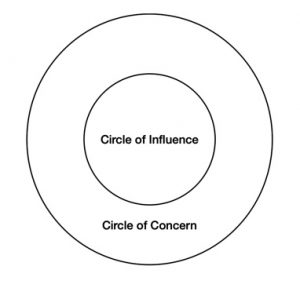
… That in turn reminded me of the late, great Stephen Covey’s “The 7 Habits of Highly Effective People.” His organization still talks about the first habit, “Be proactive,” with Covey’s Circle of Concern and Circle of Influence (4-minute video with story at link).
You can grow your Circle of Influence, Covey says, by focusing on it instead of the things outside of your control in the Circle of Concern.
And that brings to mind Roman emperor, and Stoic philosopher, Marcus Aurelius.
His “Meditations” are the journals he kept throughout his life. Perhaps never meant to be published, they read as advice from a thoughtful, world-weary person to himself. For instance:
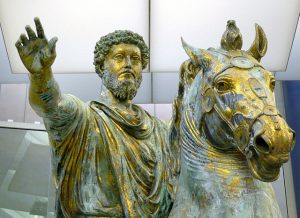
“You have power over your mind – not outside events. Realize this, and you will find strength.”
Marcus aurelius, “meditations”
I find it interesting that he says strength is not in your mind’s power but in realizing you have power there and not elsewhere.
In that view, it is no wonder St. Paul tells us that self-control is “fruit,” not “works.”
Now the works of the flesh are evident: sexual immorality, impurity, sensuality, idolatry, sorcery, enmity, strife, jealousy, fits of anger, rivalries, dissensions, divisions, envy, drunkenness, orgies, and things like these. I warn you, as I warned you before, that those who do such things will not inherit the kingdom of God. But the fruit of the Spirit is love, joy, peace, patience, kindness, goodness, faithfulness, gentleness, self-control; against such things there is no law. And those who belong to Christ Jesus have crucified the flesh with its passions and desires.
If we live by the Spirit, let us also keep in step with the Spirit. Let us not become conceited, provoking one another, envying one another.
Galatians 5:19-26
That is, the power is not in having controlling of yourself. You can’t “work” at it. You must “keep in step,” walk with the Spirit to have access to the “fruit” of self control.
I find that thought incredibly freeing.
I have watched people struggle with mental illness or events so overwhelming you wonder how they could ever have power over their mind. Christ makes a promise to those struggling: Let Him have control, and have peace (another fruit of the Spirit):
All things have been handed over to me by my Father, and no one knows the Son except the Father, and no one knows the Father except the Son and anyone to whom the Son chooses to reveal him. Come to me, all who labor and are heavy laden, and I will give you rest. Take my yoke upon you, and learn from me, for I am gentle and lowly in heart, and you will find rest for your souls.
Matthew 11:27-29
Notice that you are still responsible. You must make the choice to come to Him, to walk in the Spirit.
Still, there is a thread here from Urban Meyer’s formula, Covey’s circles and the Bible’s call to keep in step.
Which of these versions of being intentional works for you? Regardless, I hope you intend this week to wrestle and grow.