
“They just don’t THINK!”

Almost every manager and business owner I’ve served has, at some point, complained that employees are just not thinking clearly.
They are going through the motions. Or acting emotionally. Or making bad assumptions. Or just not considering consequences.
If there is one U.S. president who kept himself free of such problems, it has to be Abraham Lincoln. Despite battling depression most of his life, he was a model of clear thinking and charitable dialogue. His common-sense arguments were so logical.
What would you give to be like Lincoln? To have employees like him?
Logic: the missing piece of employee training. How do you get it?
Before 1900 or so, the answer was clear. It was part of your education.
Skills that set you free
Logic is one of the seven liberal arts, the bundles of skills one needs to be liberated–no longer a slave to bad thinking, bad leaders or one’s own emotions.
So logic itself is one of the liberal arts. But wait! There’s more!
Before logic became one of the seven liberal arts, the ancients taught, in its place, “dialectic.” You could say it is the art of argument, intentionally wrestling to the truth.
This aligns with the art of logic: Given a certain set of premises, is a certain conclusion true? You’d better prove it. …
(I find that most organizational conflicts have at their root the inability to tell the difference between premises and conclusions. More on that in future posts.)
Liberal arts are more than just practical skills. They shape you.
Grammar, another liberal art, taught clear thinking as well. Certain “dead languages” like Latin and Greek are inflected (academic writing at the link–click at your own risk). The endings of nouns and verbs change depending on things like gender, person, case, plurals, etc. To use the endings correctly is a beautiful practice in logic.
Studying number
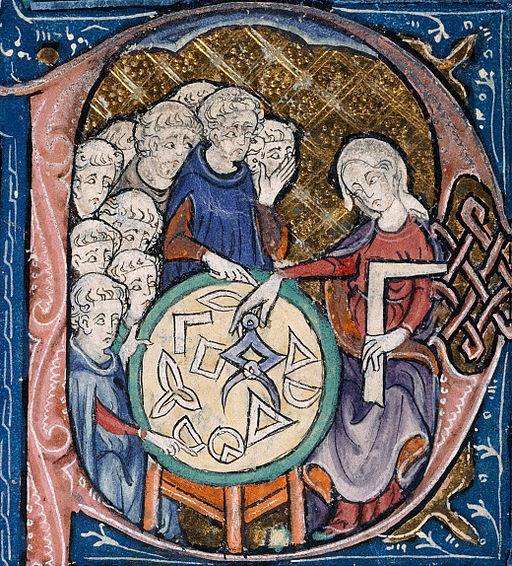
Another liberal art: geometry. It was one of four mathematical arts Pythagoras grouped together as a way to study spiritual truth–what could be more eternal and real than number itself? Plato lists them as required studies for leaders in his Republic (“… arithmetic being pure number, geometry number in space, music number in time, and astronomy number in both space and time,” as Stratford Caldecott describes).
Geometry was Lincoln’s passion.
What’s fascinating about this article on Lincoln from the Wall Street Journal is that it never once mentions the liberal arts or classical education. Lincoln’s studies were not a one-off but part of a time-honored tradition. The article mentions that he attributed his rhetoric–another liberal art!–to Euclud’s geometrical proofs (yes, same word we used to describe logic.
So Honest Abe did become a masterful lawyer, overcame depression, ran a country, won a war, and became a model of unity and charity for all leaders who followed.
You certainly can thank part of that on how the Bible formed his soul.
And you can thank another part of that on how geometry sharpened his mind.
Liberal arts are more than just practical skills. They shape you.
The question that haunts me:
Schools don’t tend to give this to students nowadays. So how do we ensure our employees get it?
I welcome your comments below. Or contact me. This is as much about what we want for our people as what we want from our people.