
I invite clients to “wrestle and grow.” That growth happens in three areas: growing more organized, growing more confident and growing more influential.
Classical culture-building
Those three words sum up my method to help clients build their cultures. But really, they are principles of classical education–the system that built the most successful and longest-lasting culture of all time: the West.
At the heart of classical education? The power of stories.
Let’s take your average, Latin-speaking Roman citizen as an example:
- He would learn the Greek language. As he became organized in the knowledge of its grammar, he would have a foundation for what was to come.
- He would learn to think, using “dialectic” as a way to converse–even argue–in his schooling. Thus he would become confident in his understanding.
- He would then wisely apply his knowledge and understanding in his rhetoric. With superior thinking and communication, he would become influential in his community.
And all of that started with stories. Perhaps the most important one was the Ancient Greek epic the Iliad.
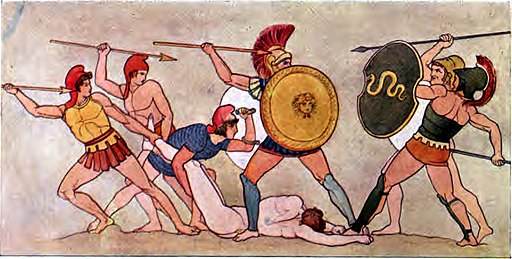
Most of us could quote some of the Star Wars movies and make references to the characters that others would understand. Imagine if much of your schooling revolved around knowing those movies by heart. And imagine that their stories were incredibly more complex. And, well, graphic.
If faithfully adapted to cinema, the Iliad would get an NC-17 rating.
The epic features many acts of brutality, including corpse abuse. It also features some of literature’s most heroic and heartbreaking scenes, with some of its most beautiful speeches.
Greeks would learn them at a young age, even before the start of formal schooling. They would be expected to recite lines and lines of the poem from memory.
And the stories would stick.
“Stories are storage”
“Stories are storage,” as my friend and colleague John Kuzava says. The Iliad and its kind were the cultural memory of our civilization. (And as the date on the book illustration above suggests, it was in our cultural memory as we approached the 1900s!)
For anyone classically educated (from the B.C. era to the early 1900s), those stories were what you studied, debated and used as inspiration.
They captivated students as they wrestled with the language.
They gave students fodder for dialectic as they debated the rightness of characters’ choices.
They inspired students to pursue “truth, goodness and beauty” in ways that transformed society for the better.
Would you like the members of your culture to have that level of engagement and ownership?
Part of the magic was that the stories really would stick. They were stored in the cultural memory, common touchstones everyone knew and could reference. (We still do, in small ways like the Achilles heel, very much a part of the Iliad story.)
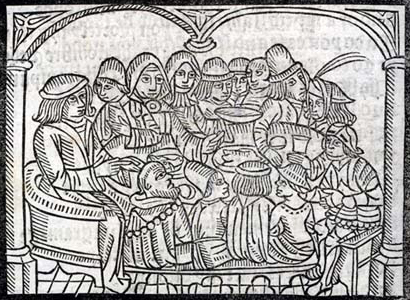
But your stories, about your culture, can stick, too.
Stories are at the heart of your efforts to build your culture. Those stories stick in the memory and give team members a common reference point for growing as an organization.
Scientists are proving it.
Heart rate and memory
A new study in the scientific journal Cell Reports shares some new research on storytelling.
In the experiments, when people heard the same narrative, their heart rates synchronized.
And when that happened, they better remembered what they were told.
Check out the study itself for more details. But just consider this:
All the statistics. All the fine-sounding arguments. All the research in the world. Your team will remember NONE of it as well as they will a good story about your organization.
If you are looking to engage your people, spend time identifying the stories of your team.
“What stories?” you ask. If this seems a little vague, I’d be happy to help you think it through. Let’s talk.