I’m still re-devouring William Gibson novels. At some point during the lockdowns, I realized we were living in his universe: corporate monopolies, pandemics, communities-in-cyberspace, alienation-via-technology … things he covered 30 years ago.
(Not David Howell Evans)

Here’s one item that, I hope, he got at least a little bit wrong: the Edge.
In his short story “New Rose Hotel,” Fox, an industrial espionage agent, is searching for the Edge.
The Edge was Fox’s grail, that essential fraction of sheer human talent, non-transferable, locked in the skulls of the world’s hottest research scientists.
You can’t put Edge down on paper, Fox, said, can’t punch Edge into a diskette.
Edge is not intellectual property, not data or information. It is the talent within certain brains. It is key to the organizations that run much of society in Gibson’s near-future: the zaibatsus. They are powerful multinational conglomerates with their own armies and citizens (de facto–staff are employed for life, with corporate tattoos, corporate funerals, even corporate hymns).
Big Pharma, etc.
Zaibatsus run much of the economy. To an alien, Fox says, they, not humans, would appear to be earth’s dominant life form:
The blood of a zaibatsu is information, not people. The structure is independent of the individual lives that comprise it. Corporation as life form.
It’s tempting to go down a train of thought here about how close we are to Gibson’s reality. Public-private partnerships have created near-monopolies: Military or pharmaceutical firms that win big contracts. Social media platforms that root out disinformation against government agendas. Manufacturing or technology conglomerates that receive tax breaks or bailouts.
There are haves–too-big-to-fail winners in the lottery for tax dollars. And there are have-nots–often small businesses. Trust in institutions is surely the lowest it has been in quite some time (see studies here and here–China and Saudi Arabia are the only really high ones, and I’m not sure I trust the results of citizens under autocracies).
Despite any public or private institutional funny business we may see, even the Googles and Facebooks of the world would probably tell you that their real Edge, their real advantage, is not in lobbying or even in their latest product or service. It’s people.
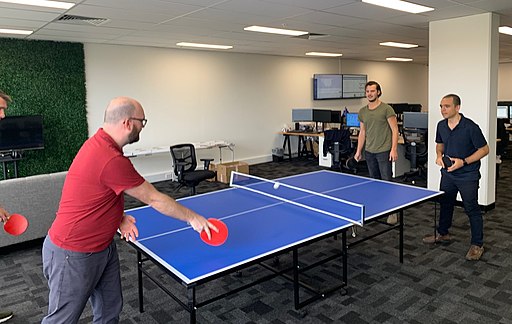
The extreme importance of attracting talent is why we used to have jokes about installing ping-pong tables in the workplace.
In Gibson’s universe, the corporations are in a shadow war: espionage, assassinations, defections. Our universe isn’t that cutthroat. Overtly. Yet. We use ping-pong tables.
Beyond ping-pong
I joke … but in some cases, businesses really thought the actual ping-pong table would bring in the talent!
In reality, it was more about what the table represented: We care about our employees. Employees stick around for that.
In fact, even if your talent isn’t top-shelf, employees will stick around and grow in the right environment.
In other words, we are back to talking about culture. I suspect that is the real Edge.
Here are some specific ways to be “sticky” to your employees–all aspects of culture:
I just talked to a man who worked with Coach John Wooden. You may know this already, but Wooden turned down a million-dollar salary and a condo on the beach coaching the Lakers. He stuck at UCLA, where he felt he could really make impacts on a bunch of young men. Purpose.
I’ve had other star employees recently tell me that they stick around because they think their business owners are people of integrity, or that they had made it so clear that they knew the star as an individual, not as a “money pump.”
Young employees have told me they picked the firm they work at because they expect to be developed there. Yes, they are literally expecting and asking for training and coaching.
What is your Edge? What are you intentionally doing to keep it?